

Appearance: Colorless clean liquid
Assay: ≥98%
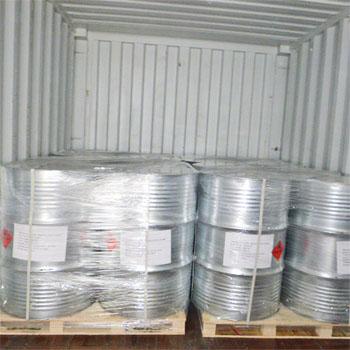
Packing: 83kg/Cylinder
Sample: available

Appearance: Colorless clean liquid
Assay: ≥98%
Packing: 83kg/Cylinder
Sample: available
Tributylphosphine CAS 998-40-3 Quick Details
Chemical Name: Tributylphosphine
Synonyms: Tri-n-butylphosphine; TBP
CAS No.: 998-40-3
Molecular Formula: C12H27P
Chemical Structure:
Molecular weight: 202.32
Appearance: Colorless clean liquid
Assay: ≥98%
Typical Properties
| Item | Specifications |
| Appearance | Colorless clean liquid |
| Purity(GC)% | ≥98 |
| Tributylphosphine% | ≤1.5 |
| Other % | ≤0.5 |
| Boiling Point | 240.0 – 243.0°C at 760 mmHg |
| Melting Point | -65.0 – -60.0°C |
| Density | 0.810 – 0.820 g/cm³ at 25°C |
| Refractive Index | 1.4620 – 1.4650 at 20°C |
| Flash Point | 37 – 40°C |
Tributylphosphine CAS 998-40-3 Usage
Homogeneous Catalyst & Organophosphine Ligand (Core Absolute Application): Functions as one of the defining tertiary phosphine ligands and nucleophilic catalysts in modern organometallic processing.
Transition Metal Coordination: It coordinates with transition metals and is extensively used in Heck reactions, Suzuki coupling, hydrogenation, carbonylation, and olefin oligomerization.
Organocatalysis: Catalyzes Wittig olefination sequences, modified Mitsunobu reactions, and conjugate Michael additions.
Biochemical & Proteomic Disulfide Reductant: Applied as a powerful biochemical disulfide cleavage agent, selectively reducing protein peptide disulfide crosslinks (-S-S-) into free thiols (-SH) across a wide pH spectrum with superior aqueous stability.
Polymerization Catalyst & Initiator: Deployed as a curing catalyst for epoxy formulations, polyurethane synthesis, and acrylic monomer polymerization.
Packaging and Shipping
Packing: 83kg/Cylinder; 180kg/sealed steel drum
Delivery: by sea
Tributylphosphine CAS 998-40-3 Store
Must be stored in a cool, dry, and well-ventilated dedicated hazardous chemicals warehouse.
Keep strictly away from open flames, ignition vectors, and direct sunlight; suggested storage temperatures should be maintained under refrigeration at 2 – 8°C, or below 25°C under desiccated conditions.
Keep containers hermetically sealed, inert gas blanketed (nitrogen/argon), and protected from oxygen.
Strictly avoid joint storage alongside strong oxidizers, mineral acids, or halogens.